
Pepi House: Happy Family
Pepi PlayEducational
4.27.02K Reviews
- Version
- 1.15.2
- Installs
- 50.00M
- Age Rating
- Everyone
Screenshots
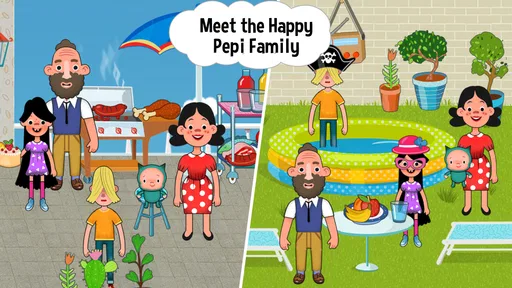
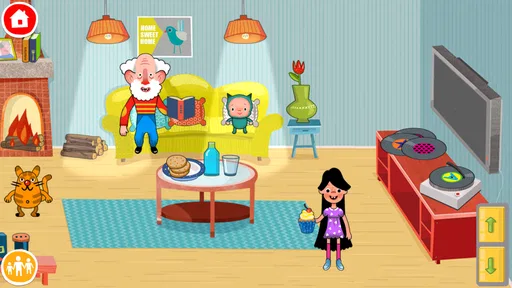
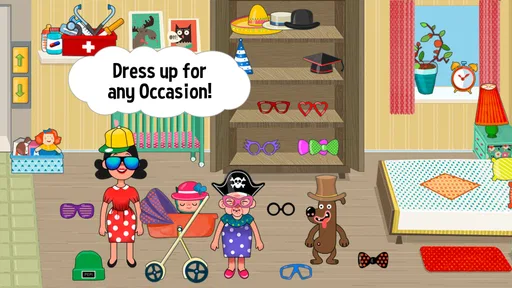
Our Review of Pepi House: Happy Family
 Analysis by Appyee
I spent time with Pepi House: Happy Family as a relaxed pretend-play game rather than a traditional level-based children’s title. Its main appeal is the freedom to explore a home, move characters around, and create small family stories at your own pace. There is no pressure to beat a timer or master a difficult control scheme, which makes it feel closer to a digital dollhouse than to a conventional game.
That distinction matters when deciding whether it is right for your child. This is an educational game from Pepi Play, but its learning comes through imitation, discovery, sequencing, and imaginative play rather than lessons, quizzes, or explicit teaching screens. I found it most enjoyable when I treated the rooms as a setting for storytelling instead of waiting for the game to tell me what to do.
How the game works in everyday play
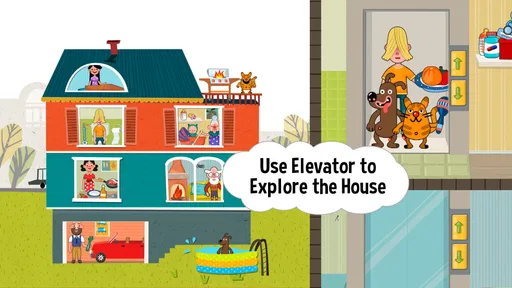
The basic experience is easy to understand: enter the Pepi city home, look around, select characters and objects, and arrange little scenes. The home setting gives children familiar situations to act out, such as getting ready, spending time with family, organizing belongings, or simply making a character interact with the environment. The short store description calls it “Pepi House,” and that simple name is a fair description of the central idea.
What I liked most is that the game does not insist on one correct story. A child can repeat the same room several times but change the roles, order, and outcome. One visit might become a morning routine, while another turns into a pretend party or a slightly chaotic family scene. That open structure gives the game more replay value than a fixed sequence of mini-games, especially for children who enjoy inventing dialogue and situations.
The controls are designed around direct interaction. Instead of learning a complicated menu system, the player can focus on choosing something visible and seeing what happens. That makes it approachable for younger children who may not yet be comfortable with reading-heavy interfaces. It also means that an adult can join in without needing to explain a long rule set first.
A realistic use case is a quiet period after school. A child can spend a few minutes moving through the home, then naturally shift into a longer story once an idea appears. I found that the best sessions were not necessarily the longest ones. The game works well as a short creative activity, while longer play depends heavily on whether the child enjoys repeating scenes and inventing new variations.
Why the open-ended design can be educational
Calling it educational does not mean it teaches in the same way as a spelling app or a mathematics game. Its value is more indirect. Children practice making choices, connecting actions into a sequence, recognizing familiar household situations, and expressing social ideas through pretend roles. When a child decides who is caring for whom, what happens next, or how a room should be used, the game becomes a small space for planning and storytelling.
I also see value in playing alongside a parent, sibling, or caregiver. Asking questions such as “What is this character doing?” or “What should happen next?” turns passive tapping into conversation. The app provides the setting, but the adult interaction often supplies the richest language practice. On its own, it is better described as a creative prompt than as a complete early-learning curriculum.
Another useful approach is to give the child a simple challenge without turning it into a test. For example, you can suggest creating a morning routine in the house, then let the child decide the order. This encourages sequencing while preserving the freedom that makes the game attractive. I would avoid correcting every choice, because the unusual or silly choices are often where the imaginative play becomes most engaging.
Cost, free access, and the meaning of value
The game is free to download, so trying the basic experience does not require an upfront payment. That is an important advantage for families who want to see whether an open-ended pretend-play format suits their child before spending money. The listed in-app purchases range from $1.49 to $1.99 per item, so the paid side is made up of small individual purchases rather than a single price I would describe as a full premium-game cost.
Because those purchases are separate items, I would make the decision based on actual use rather than assuming that every child will need them. If the free experience already provides enough room for your child’s stories, there is no reason to buy anything simply because optional content exists. If the child returns often and wants more variety, a small purchase may feel worthwhile, but the value depends on how much that particular child enjoys repeating pretend scenarios.
This is where the game differs from a paid educational course. You are not buying a structured program with a clear lesson path. You are paying, where relevant, for more play value inside a creative setting. I consider that a reasonable trade-off for children who love role-play, but less convincing for parents looking for measurable progress in reading, counting, or academic skills.
For younger players, I would handle purchases together with an adult. The practical question is not only whether an item is inexpensive, but whether it adds something the child will genuinely use. A child who quickly moves from one app to another may get better value from keeping the free version. A child who returns to the same house repeatedly may find that a small optional addition extends the life of the experience.
Where it feels strong and where it feels limited
The strongest part of the game is its low-pressure atmosphere. There are no demanding reflexes to master, and the family-home setting is immediately understandable. I could hand it to a child who prefers exploring over competing and expect them to begin experimenting without a long explanation. That accessibility is especially useful when the goal is calm creative play rather than excitement.
The same openness can also be the main weakness. Children who need clear objectives may ask what they are supposed to do after exploring the rooms. There is no obvious finish line to work toward, so the game relies on the child’s imagination to create momentum. In my experience, some players will find that liberating, while others may lose interest because they prefer missions, rewards, or visible progress.
It is also not the best substitute for a focused educational tool. If your priority is practicing letter sounds, completing number exercises, or following a carefully staged lesson, a dedicated learning app will usually be a better match. Pepi House can support conversation and imaginative thinking, but I would not choose it as the only educational app on a child’s device.
Compared with ordinary digital dollhouse games, its family setting gives play a familiar social frame. Compared with storybook apps, it offers more freedom but less author-guided narrative. Compared with puzzle games, it asks for less problem-solving and more invention. Those differences are useful when choosing: the right alternative depends on whether your child wants to create a story, follow one, or solve a challenge.
Small details that improve the experience
I found that the game works better when a child is given a starting idea instead of being told simply to “play.” A prompt such as preparing the house for a visitor, organizing a family activity, or acting out a bedtime routine gives the first session direction without taking control away. Once the story begins, children can usually change it in their own way.
A second helpful habit is to let the child take turns directing the scene. One person can choose the characters while another decides what happens next. This makes the game more social and reduces the chance that one player will move everything around without developing a coherent story. It is particularly useful for siblings who need a simple shared activity.
I would also use the app as a transition activity rather than an automatic background distraction. A short session before dinner, after a reading period, or during a quiet indoor afternoon gives the pretend play a clear place in the day. Since the game is open-ended, an adult can end a session by asking the child to describe what happened, which turns the play into a natural storytelling exercise.
One trade-off is that the child’s experience depends strongly on temperament. A child who enjoys arranging scenes and assigning roles may discover many possibilities. A child who wants constant novelty may find the home setting repetitive sooner. That is not a flaw that can be solved by better instructions; it is simply the consequence of choosing a flexible pretend-play design over a content-heavy progression.
Who is likely to get the most from it?
I would recommend it first to families with children who enjoy pretend families, household routines, and making up dialogue. It is also a good candidate for a child who becomes frustrated by complex games, because the central interaction is approachable and the atmosphere is gentle. Parents who like joining their child’s play will probably see more value than adults looking for a completely self-guided lesson.
The age rating is Everyone, and the format is clearly aimed at broad family-friendly use. Even so, the best fit is not determined by the rating alone. A child’s reading ability, attention span, and preference for open exploration matter more here than a specific age boundary. Younger children may benefit from an adult explaining the play idea, while older children may use the setting more independently as a storytelling tool.
I would be more cautious about recommending it to a child who needs explicit goals, frequent rewards, or escalating challenge. It may also disappoint families expecting a substantial academic curriculum. The educational label makes sense when understood as learning through play, but it should not be mistaken for a replacement for guided practice in school subjects.
The game has reached over 50 million installs and holds a 4.2 average from around 256 thousand ratings, with about 7 thousand written reviews. Those figures suggest that the format has broad appeal, but they do not decide whether your own child will enjoy it. Open-ended games can be very personal: one child may return to the same rooms for weeks, while another may prefer a game with clearer objectives after a single session.
Device and version considerations
The current version is 1.15.2, and it requires Android 6.0 or later. That makes the operating-system requirement worth checking before installing on an older Android device. If the device meets that requirement, the more important practical consideration is whether the screen is comfortable for a child to use and whether an adult can supervise optional purchases when needed.
I would also introduce the game when you have a moment to observe the first session. Watching how a child approaches the house tells you quickly whether the open-ended design is a strength or a problem. If they begin inventing roles and returning to scenes, the app is probably a good fit. If they repeatedly ask for instructions or lose interest without a goal, another type of game may serve them better.
My recommendation for families deciding
My overall view is positive, but specific. This is a good free starting point for imaginative family play, not a structured course and not a challenge-driven game. The free entry makes experimentation easy, while the optional purchases should be judged by repeated use instead of impulse. I would only spend on an item after seeing that the child returns to the house and has ideas for using more of it.
The best value here comes from shared storytelling, not from collecting every optional addition. That is the point I would explain to a friend before recommending it. If the child enjoys making up routines, moving characters through familiar situations, and using a digital space like a dollhouse, the game can provide a pleasantly flexible activity at no initial cost.
If your priority is academic instruction, a focused learning app will be the better purchase. If your child wants action, competition, or a sequence of missions, this may feel too loose. But for calm pretend play, especially when an adult is willing to ask questions and join the story, Pepi Play’s approach works well. I would install it for a child who likes imaginative play, try the free experience first, and treat any later purchase as optional rather than necessary.
After using it, I see Pepi House: Happy Family as a friendly digital play space with educational value that grows through conversation and creativity. It does not need to promise more than that. For the right child, its freedom is the reason to keep it; for the wrong child, that same freedom is the reason to skip it.
Verdict
Strengths of Pepi House: Happy Family
- Bright, colorful graphics are appealing to young children.
- Open-ended play encourages creativity and imaginative storytelling.
- Simple touch controls are easy for preschoolers to understand.
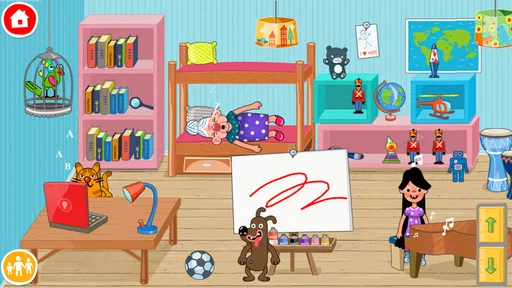
- Many characters and rooms provide plenty of interactive possibilities.
- Works well as a calm, screen-time activity without time limits.
Limitations of Pepi House: Happy Family
- Some content and features require additional in-app purchases.
- Gameplay may feel repetitive after children explore every room.
- Limited challenge may not interest older children for long.
- Frequent tapping can trigger actions unexpectedly for younger players.
- Parents may need to supervise device use and spending settings.
Other Releases by Pepi Play
View All
Pepi City: Hospital Life
Educational4.3
Similar Picks in This Category
View All
Little Panda Policeman
BabyBus4.0

Monster Trucks Game for Kids 2
Raz Games4.1

Little Panda's Chinese Recipes
BabyBus4.4

Little Panda's Restaurant
BabyBus4.4

Little Panda's Ice Cream Games
BabyBus4.3

Baby Panda Care
BabyBus3.8
Frequently Asked Questions
What is Pepi House: Happy Family?
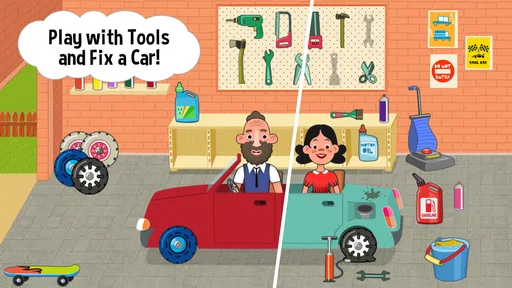
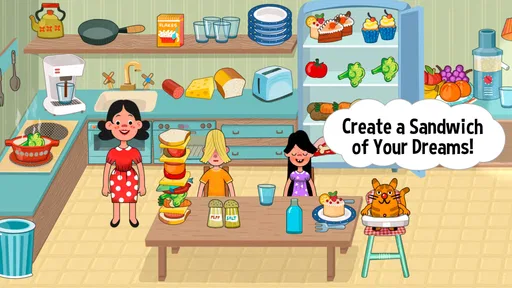
Pepi House: Happy Family is a child-friendly digital dollhouse game where players explore a colorful home and interact with a family of characters. Instead of following a fixed storyline, children can create their own scenes by moving characters, opening drawers, using household objects, preparing food, and discovering playful reactions throughout the rooms.
Is Pepi House: Happy Family suitable for children?
The game is designed primarily for young children and offers simple, open-ended play without complicated rules or difficult controls. Its bright visuals and friendly characters make it approachable for preschool and early-school-age players. Parents should still review the store listing, available settings, and device usage habits because suitability can vary depending on a child’s age and individual needs.
Does Pepi House: Happy Family require an internet connection?
Pepi House: Happy Family is generally intended to support offline play after installation, which makes it convenient for travel or situations without reliable Wi-Fi. However, an internet connection may be needed for downloading the app, receiving updates, restoring purchases, or accessing store-related features. Checking the current Google Play or App Store description is recommended before downloading.
Is Pepi House: Happy Family free to download?
The availability and pricing of Pepi House: Happy Family can differ between Android and iOS, and some content or features may be offered through optional in-app purchases. Before installing, parents should check the download page for the current price, included rooms and characters, advertising details, and purchase options. Device-level parental controls are also useful for preventing accidental transactions.
What can children do in Pepi House: Happy Family?
Children can explore different areas of the house, interact with family members, and experiment with everyday objects in a playful, non-linear environment. They may prepare pretend meals, change or move items, open containers, and create imaginative family situations. The game focuses on discovery and storytelling rather than winning, timed challenges, or a traditional level-based progression system.
Play our best games!


